This site uses cookies only to gather statistics on how the website is used
and do not collect any personal information. For details on how we use cookies and how you
can opt out, see our privacy policy.
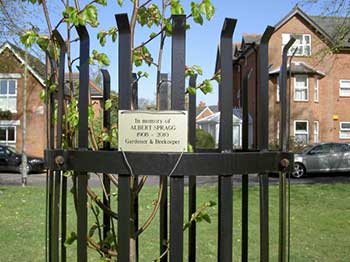
Albert Spragg memorial lime in Langborough Recreation Ground
WDVTA has recorded thousands of veteran and significant trees across the Borough, as you can see from
the veteran tree database.
WDVTA is now recording trees planted in public places for memorial and commemorative purposes
such as the lime tree planted in 2011 in Langborough Recreation Ground as a memorial to Wokingham beekeeper,
Albert Spragg.
The above map shows our recorded memorial and commemorative trees.
The icon in the top left corner in the grey area opens a side window with more display options:
The red tick boxes allow you to select just the commemorative trees or just the Jubilee oaks.
The ' v ' icons provide expanded information or additional links.
The green rectangle at the bottom toggles the satellite view.
Further options are available in full screen mode.
'What's in this folder' - a description of the commemorative tree information held here,
the commemorative and special trees map,
the commemorative and special trees spreadsheet listing the trees already recorded, where
each tree or group of trees has a reference number in the first column.
At the top of the page are two supplementary folders:
A folder with photos and supporting documents, each named with the reference number from the spreadsheet.
The folders contain photos or documents associated with that planting,
A folder with blank forms to be used for nominating trees.
If you have problems downloading any of these files please contact the
data manager
for assistance.
We are always looking for examples of other commemorative or memorial trees that should be recorded within
the Borough, whether or not they still survive. We would be especially interested to hear if there are, or were,
any trees planted in memory of people involved in the First World War.
Any information would be gratefully received especially if accompanied by details of the tree
species, location, date of planting and person or event commemorated. Photographs would be especially
welcome. If you do have some information, please use the nomination button below and fill in the form
describing the tree or trees in question.
Donated elms planted in Wokingham
16 January 2021
To celebrate the Tree Warden Scheme’s 30th Anniversary in 2020 the Tree Council
offered thirty elm trees for planting by Tree Wardens in their local network areas.
With the support of the Wokingham Town and Charvil Parish Councils, Alison Griffin and
Sarah Swatridge of the Wokingham Tree Warden Network (part of the WDVTA) submitted applications for trees to be planted in Elms Field
and Charvil Country Park. Despite the Tree Council receiving
significantly more than 30 applications nationwide the two WDVTA submissions were successful.
On the 14th January the two Tree Council elms were were planted and on the 15th
the Wokingham Society tree was also planted in Elms Field.
Delivery and planting of the trees was delayed from November due to Covid restrictions. Planting ceremonies planned for January
have now been cancelled for the time being.
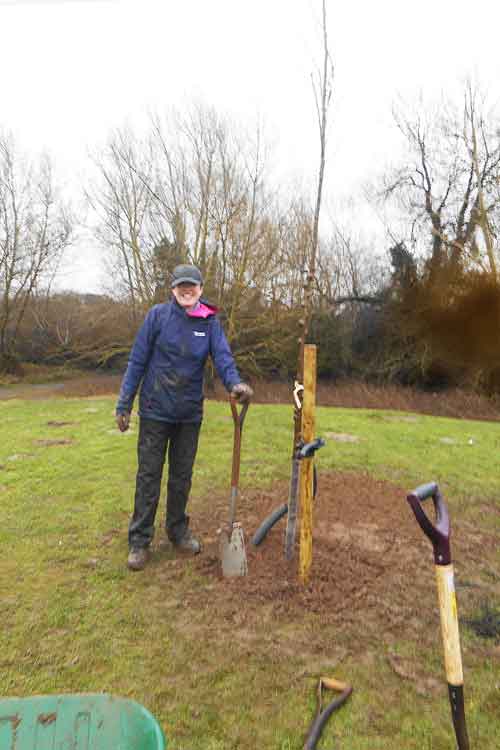
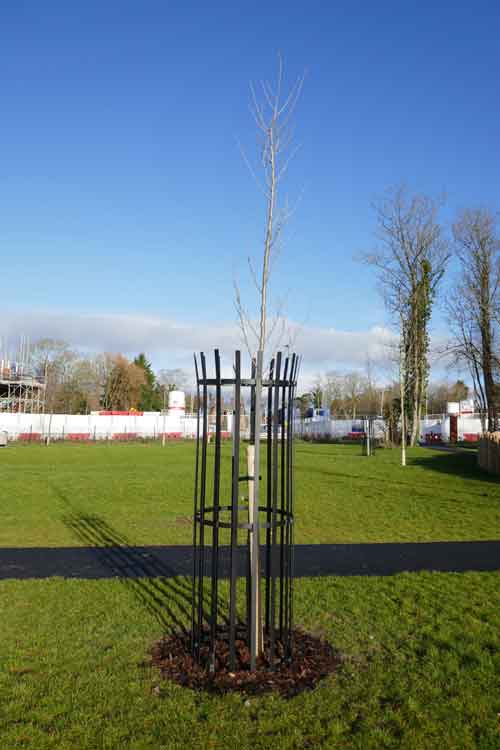
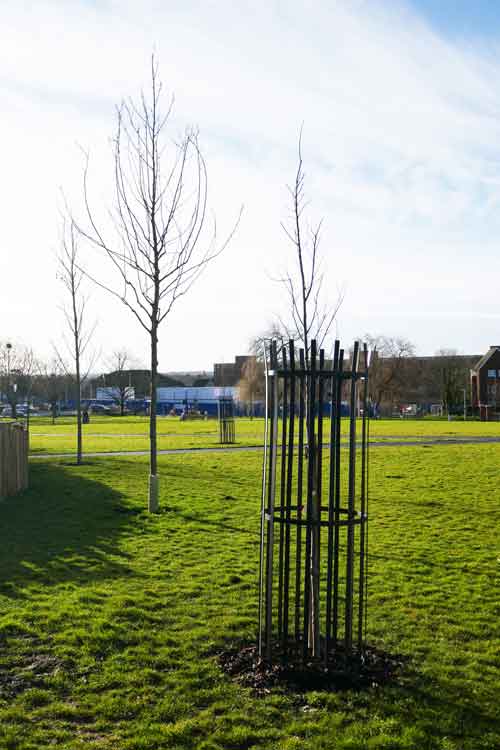
Charvil Tree Council elmElms Field Tree Council elmWokingham Society elm
The elm trees are Ulmus 'New Horizon'.
They are expected to grow to a height of 12m with a canopy spread of 4.5m after 25 years.
They are 100% resistant to Dutch elm disease, compatible with most soil types, resilient to urban conditions including waterlogging
and will tolerate a wide range of temperatures.
We have high hopes that they will become valued features of Wokingham's treescape
in years to come.
Diamond Jubilee Oak Planting
Background to the Project
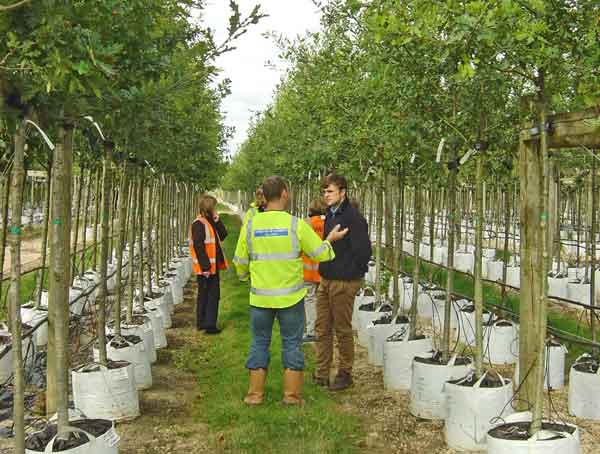
October 2012 Trees at Barcham's nursery before delivery to Wokingham Borough.
(Photo: Derek Oxbrough)
In June 2012 Wokingham Borough Council invited WDVTA to collaborate with the officers of the Trees and Landscape
team to plant 60 standard English oak trees across the borough to celebrate the Queen's Diamond Jubilee. Barbara
Stagles agreed to act as WDVTA Jubilee Trees coordinator and enlisted the support of local volunteers as well as
Oliver Ward and his team at Heartwood Tree Surgery.
The project proved a good opportunity to plant English oak trees in places where it was hoped they could grow
to their full glory. Many splendid old trees had been lost in the borough in previous years and others faced threats
from ground compaction by roads and paved areas, heavy pruning, and disease. It was thought important to try to
compensate for these lost trees as far as possible as well as to enhance the local treescape. The new trees could
also help remind people of Wokingham's history as part of Windsor Forest and give pleasure for decades,
if not centuries.
The Sites
Some 50 suggestions for sites were received by a project team consisting of WDVTA members and WBC officers and,
after careful consideration, it was decided that trees should be planted on 44 sites including public open spaces,
churchyards, nature reserves, roadside verges and school. In four sites groups of three trees were to be planted
and in five sites pairs of two. Care was taken to ensure the chosen sites were as well distributed across
the borough as possible. This map shows their eventual positions.
Buying and Planting the Trees
The trees were bought in June 2012 from Barcham Trees,
Cambridge and they were planted by Heartwood Tree Surgery,
project subcontractors, in the winter of 2012/13.
The firm was contracted to monitor and maintain the trees for five years. When planted the trees were between
five and seven years old and almost 4 metres tall. Each tree was recorded in the Woodland Trust's Royal Record
and was labelled with a numbered memorial plaque fixed to a wooden base. In subsequent years many of these
bases became rotten so the plaques have been removed and stored. There are plans to install more resistant
bases and return the plaques to the sites.
Planting Celebrations
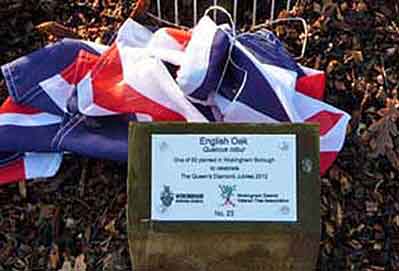
Councillor David Lee plants tree #59 at Cantley Park 21 March 2013 Photo: Stewart TurkingtonPlaque for tree #23 at Finchampstead Church
During 2012/2013 planting ceremonies involving community groups took place in the 44 sites. The first
ceremony was held at Wokingham Borough Council offices at Shute End on 24 November 2012 where the Mayor of
Wokingham Borough, Councillor, Bob Wyatt, officiated. At the ceremony in Cantley Park in March 2013,
Cllr David Lee, Leader of Wokingham Borough Council and initiator of the project, welcomed trees #59 and #60.
An interactive map of all the sites shows
their locations, photographs, information about the plantings and subsequent developments
concerning the trees.
WBC and WDVTA have published a Jubilee Oaks leaflet
(download, print and fold) to commemorate the plantings.
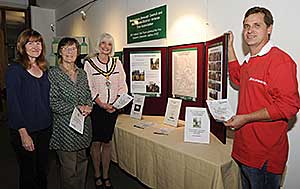
Coralie Ramsey, Barbara Stagles, Cllr. Ulla-Karin Clark (Wokingham Borough Mayor) and
Oliver Ward (Heartwood Trees) at the Jubilee Trees
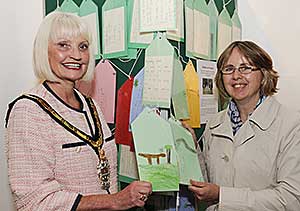
Exhibition opening ceremony at Shute End in October 2013 (Photo courtesy of WBC)Cllr. Ulla-Karin Clark and Stephanie McKay (Hawthorns School) at the Jubilee Trees
Exhibition showing riddles created by pupils at the school (Photo courtesy of WBC)
Local Benefits of the Project
As well as the trees being widely welcomed for their own sake, the planting and associated events generated
considerable community interest among voluntary groups and local residents. All the sites are attractive and
environmentally valuable and many have an interesting history. The presence of the Jubilee trees may have
encouraged people to visit previously unknown places and in some instances it has led to suggestions about
further improvements to the sites, including ideas for additional tree planting, notably an extended avenue
in Burnmoor Meadows, Finchampstead.
Jubilee Project Reviews
Five year review
In 2017 Barbara Stagles and Stephanie MacKay visited all the sites and the photos taken of the trees were added
to the website. At this stage fifty seven of the trees were thriving. Two had been replaced courtesy of Barcham
Trees. Tree #25 in Burnmoor Meadow, Finchampstead had a root canker and
tree #47 in Swallowfield Recreation
Ground had failed for no known reason. The replacements were doing well. One of the trees in Ashenbury Park
#11
had died and it was thought this might have been related to soil contamination as the land had once been a
rubbish tip. Investigations were started to obtain a replacement and plant it in another part of the park
near where Jubilee trees #12 and #13 were flourishing.
Ten year review - report
In September and October 2022 Barbara Stagles and Stephanie Mackay carried out out an extensive
survey of the trees and, with the help of Elaine Butler, WDVTA Data Manager, took photographs and updated the information
held about
the trees. This included their general condition, girth and height, crown shape and the condition of leaves,
branches, trunks, bark and root cover. They observed the size and condition of acorns including their
deformities and any oak galls. They recorded varieties of lichen growing on the trees and evidence of animal life
such as ants and other creatures. Risk conditions were noted such as proximity to main roads,
susceptibility to drought, animal damage, root compaction, invasions of other plants or vandalism including any
changes to the sites since the planting.
At this stage 55 of the original trees were found to be thriving, though some trees were flourishing better than others.
The observations raised interesting questions as to why these variations had occurred and whether other factors might
be at play such as soil conditions or pollution. These questions, however, would require more detailed study.
One of the original trees, #15 in Bulmershe Park, Woodley,
was in a very poor condition but was given additional care by Woodley Town Council grounds staff.
It has now revived, and looked in much better condition in 2023.
Another tree, #18 in Winnersh Meadows,
had been vandalised but a replacement
tree was planted by WBC after the survey early in 2023.
The replacement in Swallowfield Recreation Ground had
again failed so it was decided to plant a new young oak at a new site in Swallowfield Meadow. This small replacement tree,
one of five purchased by WDVTA, was growing well at the time of the survey.
Happily the replacement trees for
#26
in Burnmoor Meadow Finchampstead and #11 in Ashenbury Park,
Woodley were both doing well.